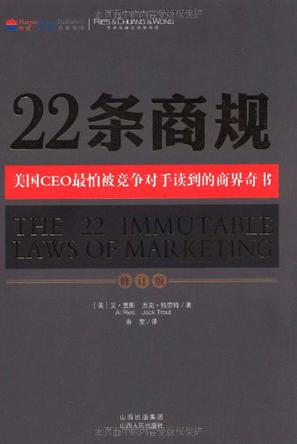

The 22 Immutable Laws of Marketing,中文译名是《22条商规》,属于营销类经典丛书。里面提到的22条基本定律,每一条都隐含着声名显赫的企业,诸如GE,通用,IMB,丰田,成败兴衰的经验和教训,每一条都价值千金。此书也被誉为企业CEO“最怕竞争对手读到的奇书”
说实话,其实有一些定律个人觉得是重复的,貌似不值得单独拿来作为一条“定律”,有几条明显是在凑数,道理都是相同的,或者是事物的两面,例如聚焦定律和专有定律,品类定律和对立定律,特性定律和之前几条,有心人可以留意一下。
作者称这22条原理为“市场营销永恒不变的定律”,所有的营销成败都走不出这22条。违背他们,必吃恶果。这个失败的单子长得无法列举..
读完之后觉得,其实这22条原理同样适用于个人的领域,把企业当成是自己,为自己定位,为自己制定好的战略,充分利用好规则,调配好自己的知识,技能,经验和资源,在商业社会分得一杯羹。
Ries和Trout在书最后是这么说的:
Marketing is not some vague and fuzzy realm where only luck matters. There are principles which can be learned and applied
其实,•市场营销过程无非洞悉客户需求,满足客户需求,建立客户关系,获得客户价值。
其中要做到三件事:想得通、做得到、赚得到。
“想得通”的理论问题,可以通过看书,思考,上课去领悟。
22条商规,定位,营销管理,消费者行为学等等,只是迈向“想得通”的第一步。
做得到”与“赚得到”的实践问题则留待你的洞悉市场基础上的决策与执行。
所以,没认为看了几本书就觉得市场营销其实挺简单。
市场营销看上去简单,但它的却不是外行人所能胜任的。
最后,祝君早臻市场营销至境:)
2012.9.13
By Hammer
====================
下面系浓缩整理的笔记:
Law #1: The Law of Leadership 领先法则
The Law of Leadership affirms the importance of being number one in a category. People usually know who the number one player is, but often cannot even name the number two
成为第一胜过做得更好。在潜在顾客心智中先入为主,要比让顾客相信你的产品优于该菱悦的首创品牌容易得多
Law #2: The Law of the Category 品类定律
The Law of the Category says that if you cannot be first in your category, setup a new category. This is really just another way of explaining a concept called "differentiation".
New entrepreneurs tend to think purely in terms of finding a product which is better than the competition. But so very often, it is more important to be different than to be better
如果无法成为第一个身份进入顾客心智,就创造一个另外的品类,是自己成为第一。
企业家总想让自己的产品“更好”,不对,要“不同”,要区别开来,在另一个品类,成为第一。
Law #3: The Law of the Mind 心智定律
The Law of the Mind says it is better to be first in the mind than first in the marketplace.
Changing the mind of an early adopter is cheap and easy. Changing the mind of a conservative or a laggard is expensive and hard
抢先进入顾客心智,胜于抢先进入市场
Law #4: The Law of Perception 认知定律
The Law of Perception says that in the battle between products, perception is more important than reality.
This concept seems unfair, but it's fundamental and we might as well get used to it
市场营销是一场争夺认知,而不是产品的竞争
市场营销并不存在事实,更不存在最好的产品,存在的只是顾客或潜在顾客心智的认知。认知就是事实,其他的都是幻觉。
Law #5: The Law of Focus 聚焦定律
The Law of Focus says that "the most powerful concept in marketing is owning a word in the prospect's mind."
就是字面意思,但是也是企业最难做到的。品牌延伸是无可避免的,但是聚焦定律的在之后作为超级终极大杀器的作用就会显示出来。所有现在成功的企业都在遵循这一定类,曾经声名显赫,现在死翘翘的大企业违背的也是这条。
如果一个公司能在潜在顾客心智中拥有一个代名词,那么这个公司必定会成功。
Law #6: The Law of Exclusivity 专有定律
The Law of Exclusivity says that "Two companies cannot own the same word in the prospect's mind."
当你的竞争对手已经拥有一个代名词或定位时,你若再想拥有另一个,将是徒劳无益的。
人们的心智中的认知一定形成,就不可能去改变它。
Law #7: The Law of the Ladder 阶梯定律
The Law of the Ladder acknowledges that in most market categories, there is actually more than one available slot in the mind of the customer.
Three Tidbits about Ladders
1. The mind of the customer can only remember a few rungs.
2. The best strategy for you depends entirely on your ranking on the ladder
3. There is a typical mapping of market share onto ladder position
产品都非生来就是平等的,潜在顾客在作购买时会对各种品牌进行排序。对于每一个品类,顾客的心智都有一个有顺序的阶梯。
所以成为不了第一,做第二,第三也不意味着失败,第二,第三的品牌也有自己的市场战略。
Law #8: The Law of Duality 二元定律
The Law of Duality says that "in the long run, every market becomes a two-horse race."
Young markets have many rungs on the ladder. They are highly fragmented. Gradually, as the market matures, players disappear and the market settles on exactly two primary players. Examples of this phenomenon are everywhere:
• Coke and Pepsi
• Canon and Nikon
• Nike and Reebok
• GM and Ford
• McDonalds and Burger King
从总体和长远的角度来看,你会发现市场往往会演化成两个大品牌竞争的局面---通常是一个值得信赖的老品牌,另一个则是后起之秀。
Law #9: The Law of the Opposite 对立定律
The Law of the Opposite says that the #2 player should generally do the opposite of what the #1 player is doing.
If you are #2 in your category, you want to be #1, right?
Wrong. You can't choose to be #1, but you can certainly choose to be #3 or #4.
The worst thing you can do is to try and beat the #1 player at his own game. Instead, realize that not everyone in the market wants to play that game. Offer those people an alternative.
必须发现领导者强大的本质,然后以其本质相对立的身份出现在潜在顾客面前。
换句话说,不要试图变得更好,要变得不同。
Law #10: The Law of Division 分化定律
The Law of Division observes that over time, a category tends to divide and become two or more categories
每一个品类总是始于某一个单一的品类,但在一段时间之后,这个类别开始分化为几个小市场。
Law #11: The Law of Perspective 长效定律
The Law of Perspective says that "marketing effects take place over an extended period of time", but the basic point of this chapter is that some marketing actions are negative in the long-term even though they seem positive in the short-term.
降价促销会使公司营业额上升还是下降?很明显,短期内是上升,长期来看,是减少公司的销售额。因为它教会顾客不要在“正常”时买东西。
长期与短期的平衡很重要,把握好时机。
Law #12: The Law of Line Extension 品牌延伸定律
The Law of Line Extension says that it is a mistake to take the name of one product and apply it to another.
Companies do this often, but it basically never works. We think that the power of the brand will help sell the new product. Instead, the brand itself is tarnished. People start to get confused about what the brand means. Quite often it is necessary to kill the second product before it causes too much damage to the first one.
这是一条几乎大部分企业都会违背的定律。
多便是少。产品越多,市场越大,阵线越长,赚的钱反而越少。“向各个方向全速出击”,似乎都各公司的口号。
什么时候他们才会懂得品牌延伸最终导致被淘汰出局的恶果呢?
今天,你若想成功,就必须集中精力,以便在顾客心目中巩固自己的地位。
Law #13: The Law of Sacrifice 牺牲定律
The Law of Sacrifice says that "you have to give up something in order to get something"
The Law of Sacrifice is all about saying "no" to opportunities. This skill is incredibly difficult to learn. I suspect that the only way to learn to say "no" is to experience the pain of saying "yes" too often.
若想成功,就要牺牲掉一些什么
有三样东西是你需要牺牲的:产品线,目标市场和不断的变化。
好运将降临在那些舍得做出牺牲的人。
Law #14: The Law of Attributes 特性定律
The Law of Attributes says that "for every attribute, there is an opposite, effective attribute."
这个有点重复了。
Law #15: The Law of Candor 坦诚定律
The Law of Candor says that "when you admit a negative, the prospect will give you a positive".
As usual, the examples from the book are mainstream consumer products:
• Listerine did it when they acknowledged that their mouthwash tastes terrible.
• Avis did it when they acknowledged that they are #2.
.
Each of these companies gained a lot when they applied the Law of Candor. People respect the courage and honesty it takes to admit that not everything is perfect.
是自己的产品深入人心的最有效方法是首先承认自己的不足,之后再将其转哈为优势。
坦诚可以可以解除顾客的戒备,相反,你的任何自夸,则最多也不过被人半信半疑。(太有道理了)
Law #16: The Law of Singularity 唯一定律
The Law of Singularity says that "in each situation only one move will produce substantial results".
• One bold stroke is much better than a bunch of small marketing efforts.
• Marketing is too important to be left to the marketing people.
在大多数情况下,你的竞争对手只有一个容易攻破的薄弱环节,正是这个环节,应该成为你全力攻击的焦点。
Law #17: The Law of Unpredictability 莫测定律
The Law of Unpredictability says, "Unless you write your competitors' plans, you can't predict the future.
Long-range planning doesn't work. We can try to observe and follow trends. We can make big-picture predictions. But if we try to make detailed plans over the long term, our competitors will surprise us and those plans will end up getting scrapped
这个同样适用于个人呢。
Law #18: The Law of Success 成功定律
Success often leads to arrogance, and arrogance to failure
成功之后容易忘记自己曾经是怎么成功过的。
Law #19: The Law of Failure 成败定律
Failure is to be expected and accepte
When you realize you've made a mistake, cut your losses
如英文
Law #20: The Law of Hype 炒作定律
The Law of Hype talks about the fact that "history is filled with marketing failures that were successful in the press".
当事情进展顺利时,公司不需要宣传炒作。而当它需要炒作时,一般来说意味着遇到了麻烦。
炒作就是炒作,真正的革命并不是正午吹号游行,也不会是晚间6点新闻报道中,真正的革命会在午夜悄无声息地到来
Law #21: The Law of Acceleration 趋势定律
The Law of Acceleration says that "successful programs are not built on fads, they're built on trends".
Fads accelerate very quickly, but often don't last long. Trends have a much slower acceleration but eventually run fast and steady. Chasing fads is expensive, so it becomes very important to learn how to distinguish them from actual long-term trends.
时尚就像海洋中的波浪,而趋势就像海洋中的大潮。时尚总会得到大肆炒作,而趋势却很少会引起人们注意。
像博洋一样,时尚是可见的。趋势则像大潮,几乎不可见。如果你面对一个迅速崛起的行业,具有时尚的一切特征,那么你最好谈话时尚,这样你就能使之流行的时间延长,从而使他更像是一种趋势。
请忘掉时尚,当时尚出现时,尽量抑制它们。保持市场对你的产品长久需求的方法之前,就是不要完全地满足需求。
Law #22: The Law of Resources 资源定律
Without adequate funding, an idea won't get off the ground".
Marketing is very expensive and you have to be prepared to spend big bucks on advertising if you want to be successful, so you're going to need a lot of funding from your VC.
最后泼冷水的章节。
没钱什么都做不了,不管你点子有多好。
市场营销是一场争夺顾客认知的游戏,你需要资金使自己的想法进入人们心目中,你需要做广告,开宣讲会,开产品报告,促销,线上线下等等,之后,一旦进入市场,你也需要资金是自己的想法继续留在顾客心目中。
依然需要很多钱。
所以,秘诀就在于:首先要有好的想法,之后要有足够的资金去运转它。融资很重要。
要想取得成功,就去找资金让营销的齿轮运转起来吧。
商业界的“万有定律”
对“商业界的“万有定律””的回应
《22条商规》热门书评
-
建议还是读《破晓—以弱胜强》吧
27有用 3无用 飞翔的肉猪 2013-08-11
《破晓—以弱胜强》已经超越了定位,《22条商规》很多就是在炒冷饭,而且还缺乏重点,相比来说《破晓—以弱胜强》的规则、方法、流程更为明确和清晰,而且逻辑结构更为严密、也更易用于实战。所以,还是看《破晓—以弱胜强》好了!下面是从《破晓—以弱胜强...
-
经典书籍的笔记
27有用 1无用 zleee 2009-05-18
战略层:1、××领域的第一厂家(有时需要创新,开天辟地一块新领域)2、本产品应集中解决一个问题;3、给产品建立与竞争对手对立的、满足客户需求的、最重要的、独一无二的一个特征属性,并进行宣传,深入人心;4、牺牲放弃一些资源,使得自己的“产品系列”、“目标市场”“不断变化”得以集中优势力量并进行突击;5...
-
一句话读懂《22条商规》
17有用 0无用 York Fernando 2014-02-16
本书的影响力和地位,在这里就不多做盛赞了。Al Ries大师洋洋洒洒写了一大堆内容,其实全书总的可以分为两大部分,按照以下思路就能形成一套完整的营销逻辑。 第一大部分:营销逻辑本身 整套营销逻辑的...
-
这也能算商界奇书?!
16有用 11无用 乌龟也会飞 2010-09-15
因为豆瓣上好多人推荐这本书,在图书馆看到这本书我毫不犹豫的选了这本,看了一部分,感觉写的很扯。第一个定律是领先定律,按照作者的观点“成为第一胜过做得更好”,“在任何品类中,领先的品牌必然是那些首先进入潜在顾客心智的品牌。”如果这条定律是正确的,那么:现在最火的服装直销品牌应该是PPG而不是凡客诚品;...
-
盛名之下
13有用 0无用 SImoN 2012-09-03
前15章讲《定位》,后7章讲怎么做。但是没有翔实的研究支撑,大部分例子都是用强烈的语气恫吓。建议还是好好读好《定位》更有用。作者(在1980年代)预言微软OFFICE最后会失败,但事实是,OFFICE成为微软现在最垄断最赚钱的工具。为什么?我觉得作者对延伸定律理解有误,当一个品牌下两个产品是高度相关...