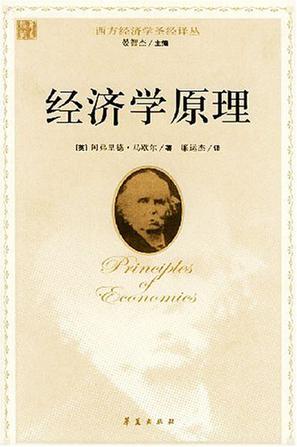
--Alfred Marshall's Principles of Economics
When I started reading this monograph, I was totally awed. This edition looks special (Unabridged Eighth Edition); the content looks special (all in sentences instead of adjectives and nouns); the appendices look special (so many interesting topics covered); the index looks special (for so lengthy a book, 6 sub-books, 55 chapters and 700 pages, no index at all); even the paper touches special, you could feel the unevenness of printed letters, and most importantly, this is Alfred Marshall.
Marshall's most important contribution, as far as I know, is laying foundations of marginal analysis in economics. There will be no economics in the modern sense without marginal analysis. Consumers are choosing among different products to equalize marginal utility. Producers are deciding production schedule to weigh marginal benefit and marginal cost. Equilibriums for labor, capital and land, the so called agents of production, and any other products are pinned down by marginal utility and disutility comparison. Monopolist maximize profits by marginal analysis too. So, from consumption, production, to market equilibrium, and income distribution, everything is contained in this framework of marginal analysis. If I'm asked to sum this book in one sentence, I would say 'marginal analysis repeated more than 1000 times'.
Marshall stuffed all mathematical deductions in the appendices and footnotes, so that this book is readable by anyone with basic English literacy. On the other hand, for an Economics textbook, if there's no math involved, the author must need succinct logic and sophisticated writing skills to convey as many clear messages as possible to the readers, just as Adam Smith did in his Wealth of Nations. I have to say Marshall's writing skills fell much short of Smith's. The coverage and depth of this book is also far more inadequate compared with Wealth of Nations. Book I to Book IV and part of Book V are written relative well, but after second half of Book V, the analysis becomes too redundant and too detail-oriented. I found it hard to even locate the topic sentence in each section. Sentences are written in a rather awkward fashion that I'm nearly lost in grasping the author's intent.
For quite a long time since I began studying Economics, the relation between Economics and Mathematics has caused much confusion to me. Firstly, there are too many mathematical equations. Linear or nonlinear programming, real analysis, KKT, Bayesian, time series analysis, and etc. Why do we need all these mathematical deductions? Sometimes I asked myself, whether I am studying the social science Economics, or I'm studying abstract Mathematics? Economics has to be a social science first, then there comes mathematics. Secondly, there are too many assumptions which are solvable but too unrealistic. For example, I can't accept the fact that economists use utility function as simple as natural log or quadratic form or CES. This seems random and unscientific. Have they done enough empirical research to prove this to be or approximately be the actual utility function of the representative consumer? In DSGE models, we simply assume several sectors maximizing their respective utility or profit function, without considering possible interaction between these sectors. Is this structure realistic? If these are not the case, the whole economics fashion is built on sand.
Recently, several incidents changed my narrow mind regarding the above confusions. I realize in some extent the current mathematical and unrealistic form of economics might be the only reliable way to conduct economic research.
As regards the mathematics confusion, a Chinese economist, Yang, Xiaokai wrote a text book 'Principles of Economics'. In the first chapter, he states that mathematics serves two functions in economics. Because mathematical language is more cogent, succinct, coherent, and logical, it fastens speed of economic thinking and communication, Besides, it also makes economic laws more convincing. Without a proper mathematical form, economist A could argue his law is more superior, while economist B could do the contrary, and the audience simply couldn't dictate who is right. Mathematical model renders this judgement possible. The very example Yang gives is Marshall. I gained the direct experience of Yang's theory in reading Principles of Economics by Marshall. Without mathematics, he has to expand the only idea of marginal analysis into more than 600 pages.
As regards the unrealism confusion, recently I read a paper by Richard Thaler in The American Economic Review (July 2016 issue). He compared traditional economics models based on rational agents as physics model in vacuum. These models are far from reality, but more realistic behavioral economists only add airborne friction to ideal vacuum models. At this stage, behavioral economics is empirical science of small steps of improvement, still unable to revolutionize the whole economics structure. Xiaokai Yang also talked about this in his book. He says economics at the current stage is like alchemy, still far from more scientific chemistry.
In a nutshell, if we want to understand worldly affairs on a theoretically convincing ground, we have to learn, use and develop economic mathematical models, plus as realistic as possible assumptions. This is the best we can get now.
Marshall did several other things very well. He states the history of Economics clearly in appendix B, from mercantile, to physiocrats, then to Adam Smith, Ricardo, Mill, American school, French economists, German school and others. He also included brief excerpts of each major economist all over his books. This is the first time I truly understand the story line of Economics. He also gives several brilliant expositions in regard to education and personal development. How to keep man from degenerating (Book III, Chapter VI), impact of hopefulness, freedom and change on men's vigor (Book IV, Chapter V), purposes of general and technical education (Book IV, Chapter VI), importance of broader view for children (Book VI, Chapter IV), and others are truly enlightening.
It is told that Marshall was very good at mathematics. When a new paper on mathematics was published in his university, Marshall would get the paper at the first available moment, only copy the first line and last line on a blackboard, then finish remaining deduction by himself. We can't expect every classic in economics to be as great as Wealth of Nations. If we ignore lack of mathematical deduction in this book, it is still a classic and worth reading.
Still a Classic
《经济学原理》热门书评
-
真正的经济学家都有一颗勇敢的心
18有用 0无用 North Laker 2008-08-21
亚当斯密的《国富论》是经济学发轫的开山之著,之前他写的《道德情操论》同样伟大。探究逐利的人性基本冲动的同时,寄希望于人类对公正和道德的不懈追求。所以受经典马克思主义理论教化成长起来的我们,在初看到亚当斯密左手是资本,右手是道德时,颇狐疑。一路上左右顾盼纷繁的经济风景线,捡起熊彼得咬一口,又摸摸哈耶克...
-
更上一层楼
7有用 1无用 璞笛 2009-01-05
斯密的《国富论》似红楼梦,潇潇洒洒,人生百态,包罗万象,挥洒自如。马歇尔的《经济学原理》则强调是严谨的态度和科学的方法,他把经济学引进了科学殿堂,殿堂里面的规矩限制了经济学的生动和活泼,但也使它更清晰、精确和逻辑。挥洒利于博大,精确利于深入。什么是科学方法?由生活中现象入手,提出解释现象原因的假设,...
-
结构编排有严重问题,目录起不到提纲挈领的作用
4有用 1无用 hjbrave 2013-04-30
我读马歇尔《经济学原理》感到心理不适。也不知道【此书目录有这么多的续前,此书的节标题这么长】是马歇尔所为还是翻译者所为?我想写书的人应该先好好学习如何写书,再来谈学问。这本书的目录编排有严重问题。1.不可以有续前。如果一章内容没有写完你继续写就是了,写了几节就分一章算什么意思?难道出版社是按章计算稿...
-
关于本书序
3有用 1无用 跳蚤 2008-09-17
一个中国人在1964年写的序,是谁忘了!写的怎么样就不说了,本人对这个序有些其他的看法!读本书的人倒是可以从历史的角度好好看看这个序!挺有意思,一开始看完半本书,觉得该把这序删了,后一想留着也好,读者从自己的角度看吧!提醒一下,正确对待历史意见!...
-
第一章绪论-关于贫穷
2有用 2无用 cate 2014-07-05
这本书堪称神书。第一章绪论快看完了,有几段极为深刻。下面这段简直就是描述现在中国的各种北漂,上漂,广漂的。他们以爱上帝和人类为乐事,他们甚至还许有某种自然的情感方面的修养,所以他们所过的生活可能比许多有较多物质财富的人的生活更为充实。不过,话虽如此,他们的贫困对他们总是一种巨大的而且差不多是纯粹的祸...