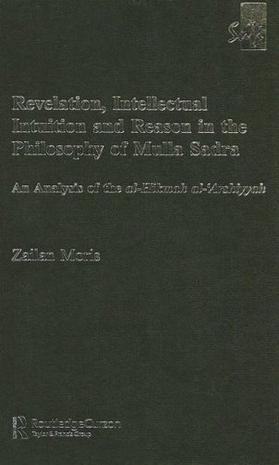
Revelation, Intellectual Intuition and Reason in the Philosophy of Mulla Sadra
作者:
Zailan Moris
出版年:
2003-9
页数:
240
定价:
$ 220.35
ISBN:
9780700715022
内容简介
Many Islamic philosophers and scholars of Islamic Philosophy consider Mulla Sadra's (1572- 1641) philosophy to be a synthesis of principles and doctrines drawn from revelation (wahy), gnosis o...
(展开全部)
Many Islamic philosophers and scholars of Islamic Philosophy consider Mulla Sadra's (1572- 1641) philosophy to be a synthesis of principles and doctrines drawn from revelation (wahy), gnosis or illuminative knowledge ('irfan/ma'rifah) and discursive philosophy (al-hikmah al- bathiyyah). This book investigates whether there is such a synthesis in Mulla Sadra's philosophy, how this synthesis is effected and finally whether it is successful. The examination and demonstration of Mulla Sadra's synthesising method is mainly based on his book al-Hikmah al-'arshiyyah or Wisdom from the Divine Throne. The book bases the evaluation of his success on the internal coherence of his ideas, their conformity to Islamic religious teachings and their impact on the Islamic thinkers after him. The question of reconciling and synthesising the three sources of knowledge to create a coherent and articulate philosophical perspective is of great import and significance not only in Islamic philosophy but also in the field of philosophical enquiry generally. His method of dealing with these three sources of knowledge discloses new insights, brings new understanding and suggests a new manner of approaching them. Although, both Islamic and western Philosophy share a common heritage in ancient Greek philosophy, they have taken diverse courses of development since the European Middle Ages. This divergence is due in part to their radically different treatments of the fundamental sources of knowledge available to man. In the west, especially since the Renaissance, reason and sense experience began to play an almost exclusive role in man's quest after true and certain knowledge. In the Islamic world, reason became more and more aligned with intellectual intuition and both were made subordinate to revelation. The examination of Mulla Sadra's synthesis discloses the epistemological orientation of a major Islamic philosopher who was a contemporary of Descartes. Thus, it offers a basis for the understanding of the diverse epistemological perspectives of the Islamic and Western philosophers since Ibn Rushd or Averroes in the twelfth century.
您对《Revelation, Intellectual Intuition and Reason in the Philosophy of Mulla Sadra》有什么评价吗,点击右上角“我想说两句”,说出你的看法吧。
有什么“读后感”吗?您可点击右上角“我要写长评”来进行评价噢。
猜您喜欢读
网友关注
网友关注
精品推荐
分类导航






























评价“Revelation, Intellectual Intuition and Reason in the Philosophy of Mulla Sadra”