

Many people has read the book “The Mckinsey Way”, well, it’s really a wonderful book. The first Three parts are of help to people who want to know how to think and solve the business problems.
The first part: The McKinsey way of thinking about business problems.
The solution to any business problem should be:
1)Fact-based:Fact are friendly, which are the bricks with which you will lay a path to your solution and build pillars to support it. Don’t fear the facts.
2)Rigidly structured: Feel free to be MECE(Mutually Exclusive,Collctively Exhaustive). To Structure your thinking when solving business problems (or anything, for that matter), you must be complete while avoiding confusion and overlap.
3)Hypothesis-driven: Solve the problem at the first meeting-the initial hypothesis. Solving a complex problem is like embarking on a long journey. The initial hypothesis is your problem-solving map. It can be break into three section:(1)Defining the initial hypothesis,find the key drivers.(2)Generating the initial hypothesis, make an actionable recommendation regarding each driver.(3)Testing the initial hypothesis.
Developing an approach
1.The problem is not always the problem. Sometimes a business problem will land on your desk and you will be told to solve it. Fair enough. But before you go rushing off in any particular direction, make sure you’re solving the right problem–it may not be the one you were given.
2. Don’t reinvent the wheel(part1). Most business problems resemble each other more than they differ. This means that with a small number of problem-solving techniques, you can answer a broad range of questions. These techniques may be somewhere in your organization, either written down or in the heads of your fellow employees. If not, use your experience to develop your own tool kit.
3….But every client is unique(no cookie-cutter solutions) That there are many similarities between business problems does not mean that similar problems have similar solutions. You have to validate your initial hypothesis( or your gut) with fact-based analysis. This will put you in a much better position to get your ideas accepted.
4. Don’t make the facts fit your solution. Avoid the tempatation to view your initial hypothesis as the answer and the problem-sloving process as an exercise in proving the IH. Keep an open and flexible mind. Don’t let a strong initial hypothesis become an excuse for mental inflexiblility.
80/20: The 80/20 rule is one of the great truths of management consulting and, by extention, of business.
DON’T BOIL THE OCEAN: Don’t try to analyze ecerything. Be selcetive;figure out the priortities of what you are doing.
The elevator test: If you have a lot of recommmendations, stick to the three most important- the ones with the biggest payoffs.
Pluck the low-hanging fruit: Don’t wait! Solving only part of a problem can still mean increased profits.
Hit singles: You can’t do everything, so don’t try. Just do what you’re supposed to do and get it right. It’s much better to get to first base consistently than to try to hit a home run–and strike out 9 times of 10. There are three reasons:
1)It’s impossible to do everything yourself all the time.
2) If you manage it once, you raise unrealistic expectations from those around you.
3)Once you fail to meet expectations, it is very difficult to regain credibility.
Lkki at the big picture: Every onw and then, take a mental step back from whatever you’re doing. Ask yourself some basic questions: How does what you’re doing solve the problem? How does it advance your thinking? Is it the most important thinkg you can be doing right now? It it’s not helping, why are you doing it? How does what you’re doing fit into the big picture? A particular analysis may be intellectually correct, even interesting, but if it doesn’t take you closer to a solution, it’s a waste of time.
Note for “The McKinsey Way”(1)
对“Note for “The McKinsey Way”(1)”的回应

《麦肯锡方法》热门书评
-
管理咨询的寓言
335有用 16无用 人造天堂 2008-04-30
http://bizchedan.blogbus.com/logs/47197187.html先来听几个管理咨询的笑话。有人找到牧羊人:“我愿为您服务,告诉您有几头羊,您需要支付我一头羊作为报酬。”他调动卫星拍照,忙碌计算,报了个数,果然正确,就牵了一头走。牧羊人叫住他:“如果我猜出你的职业,能否还...
-
麦肯锡方法完整读书笔记
220有用 4无用 Veritaz在规划 2010-06-21
第一部分:麦肯锡思考企业问题的方法 一、建立解决方案 1.以事实为基础: 对收集事实的积极态度,必须不害怕、不逃避事实 2.严格的结构化: MECE原则(相互独立、完全穷尽)。对事件细节的归类一般可以分为三种,或者加一个其他类。这三种分类必须相互独立没有交集,且每...
-
我看麦肯锡方法
91有用 3无用 不及格大博士 2008-04-18
书评人: 荣振环 作为世界上最牛的咨询公司之一,麦肯锡有很多理论和分析问题的方法值得我们从事咨询业的人学习体会。 尽管它来到中国也曾水土不服,曾经兵败实达,但是不能用人家的几次不足否定人家的长处。 对于麦肯锡,咨询业内流传一个这样的故事,有一个老头,正在草地上放羊,忽然走来一...
-
我喜欢的一些句子(有时间可以看看,小书,读起来很快)
70有用 2无用 Zheng 2009-10-23
□没有什么比忙忙碌碌更容易,没有什么比事半功倍更难。□问题与方法也是共存的。□效率是‘以正确的方式做事’,而效能则是“做正确的事□工作的过程就是解决一个个问题的过程。□医生不会马上就相信病人的结论。他会翻开病历,问一些探究性的问题,然后再做出自己的诊断。□搞清楚交给你的问题是不是真正的问题,惟一的办...
-
麦肯锡方法笔记
63有用 1无用 [已注销] 2010-06-21
第一部分 麦肯锡思考企业问题的方法1. 建立解决方案 以事实为基础 严格的结构化 &nbs...
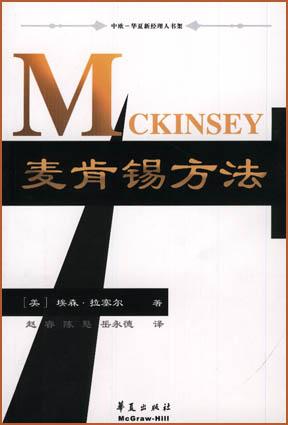
书名: 麦肯锡方法
作者: [美] 埃森·M·拉塞尔
出版社: 华夏出版社
译者: 岳永德 | 赵睿
出版年: 2001-1
页数: 177
定价: 25.00元
装帧: 平装
ISBN: 9787508022291